
The ancient city of Xanthos is known for its rich history, the suffering it endured, and its many important coins. Historians write that the city was destroyed or burned many times, but new cities sprouted from its ashes.
The ancient city of Xanthos is located in the village of Kınık, 18 km from Kalkan on the Fethiye highway. The city was built on two hills overlooking the plain along the Xanthos River (today's Eşen Stream).
The first is the Lycian Acropolis, a walled structure rising steeply from the Eşen Stream; the second, to the north, is the Roman Acropolis, which is higher and larger.
It is referred to as "Arnna" in inscriptions written in the Lycian script. Homer writes that the people of Xanthos, under the leadership of Sarpedon, participated in the Trojan War; this event is also mentioned in the oldest written records of the city.
The city was besieged by the Persian commander Harpagos in 546 BC. Despite the heroic resistance of the Xanthosians, the desperate population killed their women and children, set the city on fire, and left it abandoned and in ruins for Harpagos.
Eighty families who were not in the city at the time survived this mass suicide and rebuilt their city with newly arrived immigrants.
Between 475 and 450 BC, Xanthos faced another fire disaster. After this fire, confirmed by excavations, the city experienced significant growth and established warm relations with the western world, especially Athens.
During Alexander the Great's campaign, the Xanthosians resisted Harpagos. From 309 BC onwards, they were forced to submit to the rule of the Ptolemaic dynasty of Egypt and later, like many Lycian cities, to the rule of King Antiochus III of Syria.
In the 2nd century BC, Xanthos became the capital of the Lycian League.
It was destroyed by the Roman Brutus in 42 AD, but later rebuilt through the efforts of Emperor Marcus Antonius.
In the 1st century AD, under Roman rule, a triumphal arch was built in Xanthos in the name of Emperor Vespasian, and most of the Roman structures that survive to this day were built during this period.
During Byzantine rule, Xanthos became a bishopric center and gained many new buildings. However, after the 7th century, due to Arab raids, the city was abandoned and existed as a small village in nearby Kınık until its rediscovery and subsequent looting in 1938.
Excavations have been carried out in the city by French archaeologists since 1950.
Both acropolises of Xanthos are surrounded by city walls exhibiting various construction techniques; the polygonal wall surrounding the Lycian acropolis from the east dates back to the 4th century BC.
The wall to the south...
Some of the walls on the Eşen River side consist of regularly shaped blocks from the Hellenistic period. Other walls, constructed with mortar, date from the Byzantine period.
The area north of the Byzantine wall remains is occupied by a Roman-era theatre.
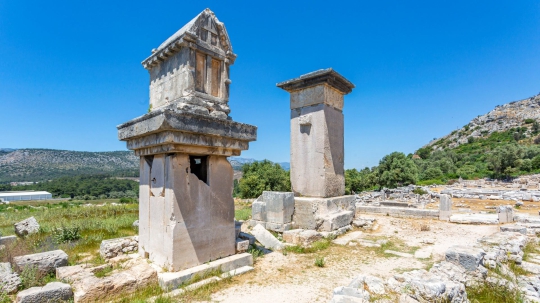
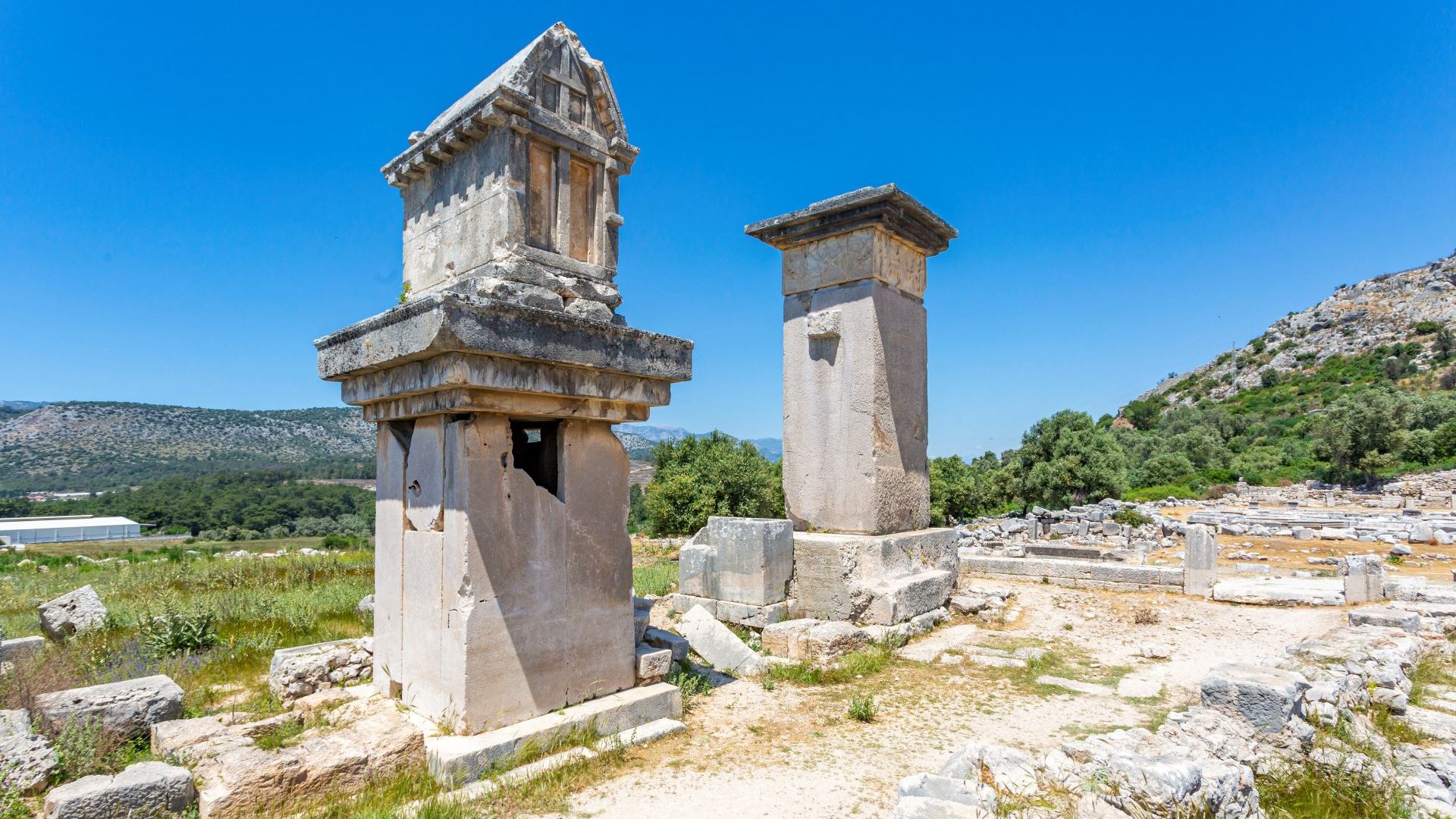
The most interesting remains of Xanthos are located west of the theatre. The first of these is a relief depicting a Harpy, a female-bodied, bird-winged creature believed to carry the souls of the dead to heaven, alongside a deceased family on a high rectangular pedestal.
The Harpy monument, whose original blocks are now on display at the British Museum, dates to the 5th century BC; next to this monumental tomb is another Lycian sarcophagus on a pedestal dating to the 4th century BC.