

In ancient times, Kibyra was located at the intersection of the Lycian, Carian, Pisidian, and Phrygian cultural regions, at the very center of trade routes opening from north to south and east to west. The region was known as "Kabalia" in ancient times and "Kibyratis" during the Roman Empire.
Although its meaning is not yet definitively known, the name Kibyra is not a Hellenistic name. The general consensus is that it belongs to the language spoken by the Luwian people, an ancient Anatolian people who were widespread in Western and Southwestern Anatolia during the Late Bronze Age, and that this unknown first name transformed into the formula "Kibyra" in the Hellenistic dialect.
According to the records of the traveler Strabo from Amasia, the Kibyrians were originally Lydians who migrated from there to Kabalis. Strabo reports that these migrants settled in a region lacking in income sources, subjugated the Pisidians and other peoples living there, and significantly altered their settlements, establishing a city the size of 100 stadia.
The same source also emphasizes that four different languages were spoken in Kibyra: Lydian, Sulaiman, Pisidian, and Greek.
Strabo's account of the city's relocation is supported by archaeological findings at the ancient settlement of Uylupınar, approximately 18 km from Kibyra. Spread across the rocky hills surrounding Uylupınar village and along the shores of Lake Gölhisar, the settlement contains continuous finds from the Early Iron Age.
In other words, this settlement is likely the area where the people of Kibyra settled before moving to their present city, probably in the 4th–3rd centuries BC. All the architectural remains of the city visible today belong to the Roman period.
Kibyra was under the rule of the Kingdom of Pergamon during the reign of Eumenes II (197–159 BC).
Immediately afterwards, the Tetrapolis of Kabalis (the Four Cities of the Kabalis Region), comprising Kibyra and the surrounding ancient cities of Bubon, Balboura, and Oinoanda, played a significant role in the political history of the region during the 2nd–1st centuries BC.
This Tetrapolis was a voting decision-making mechanism with representatives from each city. In this political union, Kibyra had two votes, while each of the other three cities had one vote.
According to Strabo, Kibyra had two votes because it could contribute 30,000 infantry and 2,000 cavalry to the union's army.
Historical records indicate that this union was disbanded and abolished by the Roman general Murena in 82 BC. Indeed, after this date, Kibyra was incorporated into the Province of Asia, while the other cities were included in the Lycian League.
During the Roman Empire, it became the judicial center of the governor of the province of Asia.
The city, which was devastated by a major earthquake in 23 AD, received a five-year tax exemption and financial assistance from Roman Emperor Tiberius. Thanks to this, the city was rebuilt, and the people of Kibyra showed their gratitude to the emperor by changing the city's name to "Caesarea Kibyra".
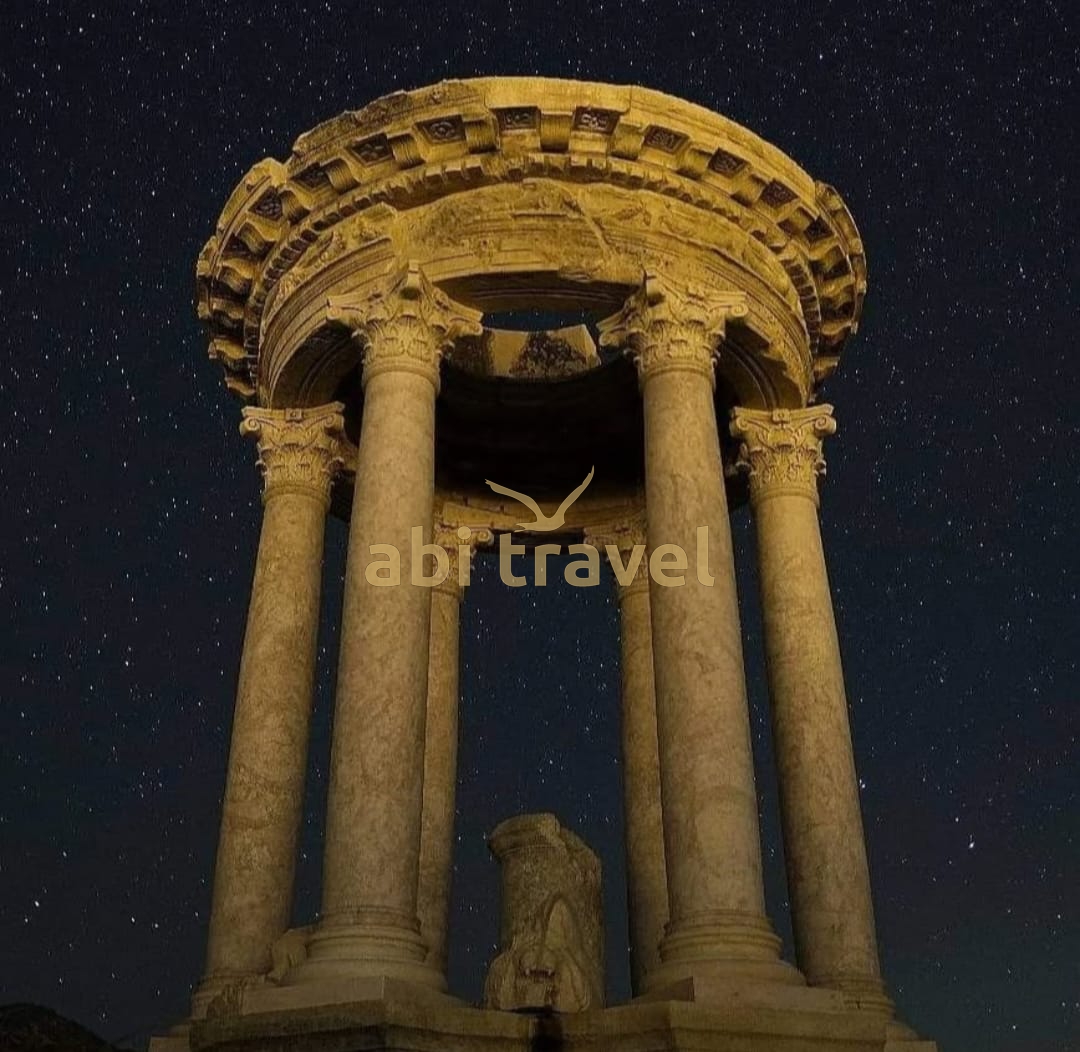
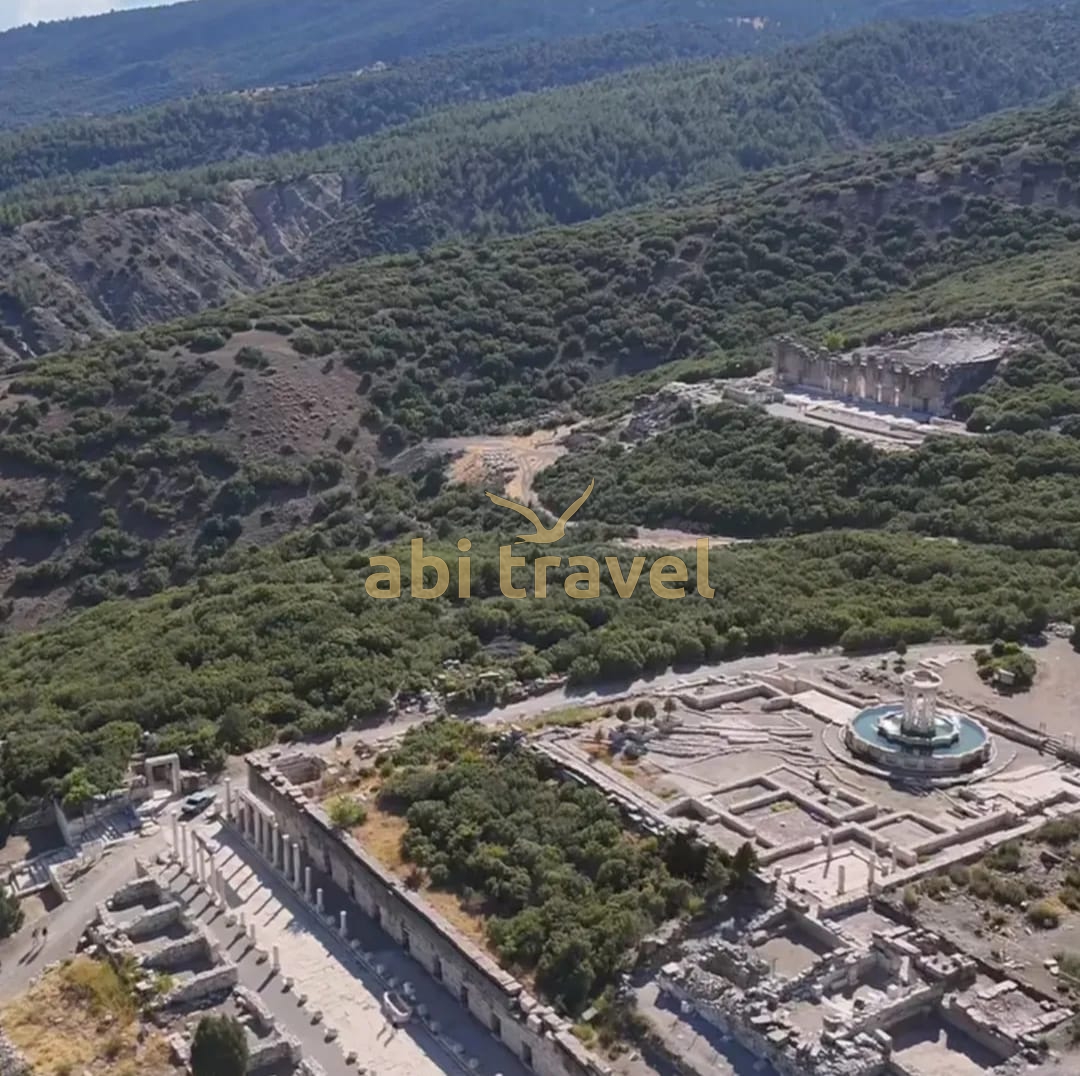
The main city of Kibyra is situated on three prominent hills separated by deep valleys. Public, civic, and religious buildings are symmetrically arranged on these hills, forming an integrated structure.
The buildings are terraced on the hills, offering commanding views of the lake and the plain, and are positioned so that no building obstructs the view of another.
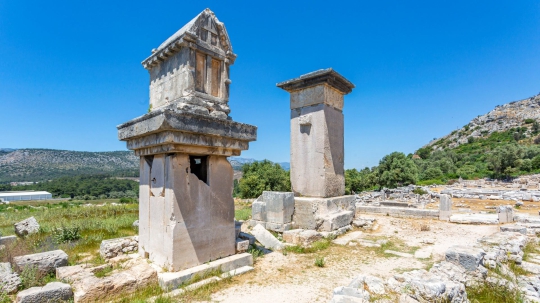
The city's necropolis (cemetery) contains numerous and diverse architectural types and surrounds the main hill, where the public buildings are concentrated, on three sides.
These buildings are concentrated between the Stadium in the east and the ridge in the west where the Theatre and Assembly Building are located.
Along the same axis are the main street, secondary roads, the basilica (which also served as an administrative and judicial building), temples, and the social and commercial marketplace (Agora).
Furthermore, the presence of small businesses, which document the vibrancy of the city's economic life, is also noteworthy.
According to information obtained from ancient sources and inscriptions, Kibyra was particularly famous for blacksmithing, leather production, and horse breeding. Research has revealed that ceramic production was especially intensive.